skip to main |
skip to sidebar
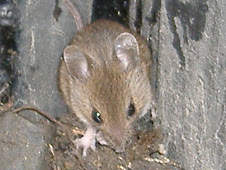
 A comment on my previous posting regarding the wild flower meadow, made me realise that I had not fully explained the way that managing the meadow benefits the wildlife that inhabits it. So I am grateful that this was pointed out to me. Sometimes it can be difficult to know if by assuming some knowledge or experience, I am going over the heads of people. Or worse still by over explaining I know I risk sounding condescending. Therefore I do welcome comments and questions, I may not know the answer mind you as I am only a simple mouse.
It is true that by cutting the vegetation off of a flower meadow will open up the area to some predators, especially airborne ones, but the overall effect is much more positive. In the winter a lot of the vegetation would die back anyway exposing the voles, frogs, mice etc to predators. However, by cutting now, the small creatures are able to relocate from breeding areas to what will become their winter quarters sooner. Over the many centuries of cutting meadows for hay, there has been an evolutionary behaviour shift that allows them to cope with this. Also by cutting down the vegetation, some will inevitably get left in the field, this becomes food for the insects and the insects become the food for the frogs and toads. Further, by cutting the meadow, more seed from the wildflowers drops to the soil. Some of these will be eaten by the mice, voles and shrews, some will be eaten by birds, some however will have the chance to spread to fresh ground via wind dispersal, or passing through the guts of birds, complete with their own manure package, or on the feet and paws of other larger animals.
The tricks of old agricultural practices often did have a beneficial effect upon the wildlife. That is one of the problems with modern chemical and industrial methods; they leave little or no room for the wildlife. Therefore to protect crops from insect damage, crops have to be sprayed, as the absence of wildlife means that there is nothing to stop the insects from eating its way through a crop. Sometimes we forget that while yields were lower in the days before chemicals, it was the wildlife that did most of the protecting of the crops. It was not perfect but it worked well for nearly two thousand years.
Incidentally, in recent years farm subsidy payments have been encouraging farmers to take better care of the wildlife by creating wildflower strips and beetle banks etc, and the farmers that have done this have needed to spray less frequently. Thus reducing their costs of production. There is obviously a lesson for us all to learn here.
The Image is of a Greenbottle Lucilia caesar
 While I am a strong believer in allowing open access to the countryside, I also realise that there are some people who don’t care about the environment and come into the natural environment set on causing damage. The photograph of this damaged tree is just one example of the damage that irresponsible people do.
Today, the Mouse and the Chair had to complete the cementing in of the rocks in the Coal Tubs. This was becoming urgent as already the mindless ones were trying to destroy the work already done. Some of the content of the tubs, not concreted in, had been removed and the rocks used as projectiles to attempt to damage the tubs and the work already done.
It would be all to easy to become despondent, but with a pragmatic attitude, we worked to complete the task and ensure that there is little that can be damaged. I personally have never understood the drive or motivation to destroy. I suppose that because it’s easier to destroy something than to create, it must provide the brainless some form of creative outlet.
With that task completed we only need to get our willing band of volunteers to join us to paint the tubs now. You are welcome to join us.
That done, the Chair and myself were not finished as we also had the job of dealing with the wildflower meadow.
As the British landscape is an artificial one, created by thousands of years of human intervention, the traditional wildflower meadow is a habitat that requires careful management. In the past, meadows would have been clearings created when trees were felled to provide hay and herbage for animals and livestock. Because there was no active inputs into the soil from manure, as would happen in a pasture meadow, and the grass and herbage are removed, the soil remains poor and denuded of nutrients. This makes the land poor for growing crops, but a perfect environment for the wild flowers, as the grasses are not able to take over.
Thus with the changes that have occurred in agricultural practice over the last fifty to sixty years, many of the traditional wildflowers have become scarce. By recreating a wildflower meadow, we ensure that the flowers exist as well as the insects and the reptiles and amphibians that feed on the insects. While the biodiversity is much grater than just that, it gives you an example of why these areas are so important.
But, as people no longer keep the odd pig, or a house cow, or even a goat or two, traditional meadows are no longer a part of the agricultural necessity. Thus managing them becomes more labour intensive. Thus the work falls to us volunteers to do the work.
Fortunately, the Friends’ have some good contacts and supporters and we got the woman who has the Alpacas in to cut the hay. But the real work is raking up and removing the hay. That is what the Mouse and the Chair did today.
The benefits to the wildlife were obvious right from the start as there were several common frogs Rana temporaria in the area and as the herbage was raked up they were hopping away to find cover. Also as the ground was cleared a large number of vole and mouse holes were revealed too.
While all of this was hard work, the benefits to the natural environment were obvious and while it is harder to create something worthwhile, that effort is justified.
 A comment on my previous posting regarding the wild flower meadow, made me realise that I had not fully explained the way that managing the meadow benefits the wildlife that inhabits it. So I am grateful that this was pointed out to me. Sometimes it can be difficult to know if by assuming some knowledge or experience, I am going over the heads of people. Or worse still by over explaining I know I risk sounding condescending. Therefore I do welcome comments and questions, I may not know the answer mind you as I am only a simple mouse.




 Posts
Posts

